The Rise of the Life Sciences Powerhouses: How the UK’s Major Cities Are Shaping the Future of Innovation
Qaisar Rafiq, Senior Director – European Business Development at Kadans Science Partner, and Veronika Khasapova, MSc International Real Estate and Planning, on the future of innovation in major UK cities.
Across the United Kingdom cities are transforming into powerful hubs of scientific innovation.
Once known for academic tradition or industrial heritage, these urban centres are evolving into dynamic ecosystems where research, enterprise, and investment collide. This evolution isn’t just about infrastructure, it’s about rethinking how and where innovation happens.
At Kadans, we have seen first-hand how today’s breakthroughs rarely emerge in isolation. The most meaningful progress is born from collaboration, between disciplines, sectors, and people. Traditional academic silos, while still essential, often lack the speed, flexibility, and cross-pollination that modern science demands. In contrast, place-based ecosystems foster the kind of spontaneous interaction and interdisciplinary exchange that fuels discovery.
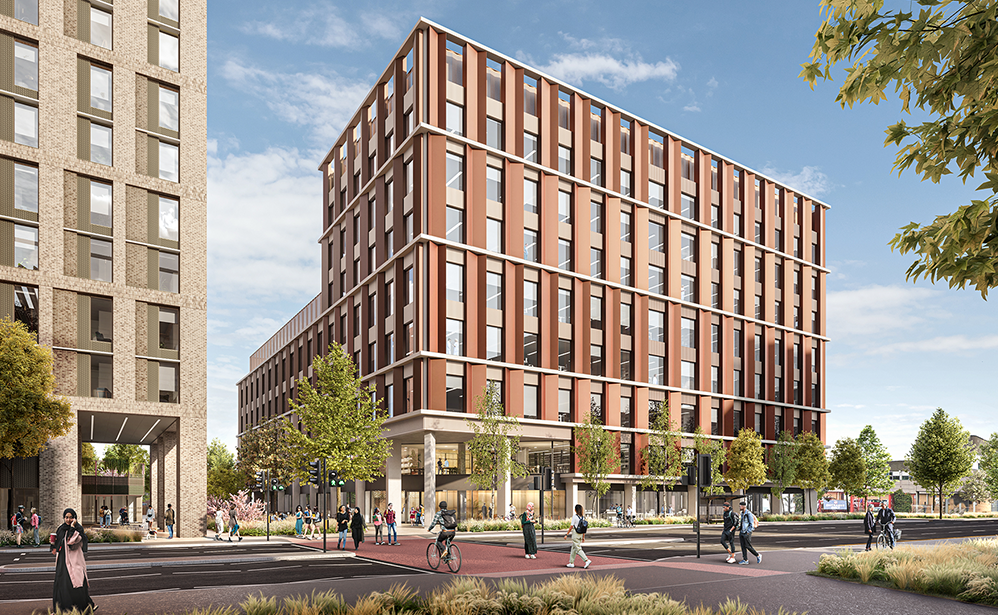
Life sciences thrive where researchers, entrepreneurs, and investors connect seamlessly, and that’s precisely what these ecosystems enable.
It’s not just lab space that drives innovation; it’s the environment, the culture, and the community that surrounds it.
Nowhere is this clearer than in the Golden Triangle: London, Oxford, and Cambridge – ranked third globally for life sciences excellence. Linked by elite universities, research parks, and world-class infrastructure, this region captures the majority of UK life sciences talent and investment.
In London, the MedCity network integrates world-class hospitals, universities, and ventures. At King’s Cross, Mayde anchors the Knowledge Quarter, the UK’s most research-intensive square mile with regulatory-ready labs designed for agile growth. In Canary Wharf, One North Quay, the UK’s first vertical life sciences campus, reflects a shift toward integrated innovation where biotech, AI, and fintech converge in a global finance hub. The proximity of the MHRA, NHS, and Genomics England cements its strategic role in shaping healthcare innovation.
Further north, Cambridge continues to lead Europe in biotech, particularly in genomics, oncology, and computational biology. Kadans’ Merlin Place supports this momentum with high-spec, flexible space that bridges research and commercialisation. Meanwhile, Oxford combines academic and clinical strength, with our portfolio supporting everything from early-stage drug discovery to GMP-adjacent device development.
But this momentum isn’t limited to the South. Glasgow is emerging as a precision medicine leader, with our upcoming Health Innovation Hub set to anchor a growing ecosystem. In Manchester, home to Europe’s largest clinical-academic campus, developments like Upper Brooke Street are enabling medtech, diagnostics, and digital health to scale rapidly. These cities are not satellites – they’re strategic centres in a more distributed, resilient innovation network.
This decentralisation is vital. It brings talent, opportunity, and infrastructure to new places, diversifying the sources of innovation and expanding the UK’s global impact.
At Kadans, our vision extends beyond lab space. We are building the connected environments where science, business, and investment intersect, and where ideas become reality. The rise of the UK’s life sciences cities is no coincidence. It reflects a deliberate strategy: to unite talent, infrastructure, and investment into ecosystems that are not only capable of solving global challenges but accelerating the pace at which we solve them.
This is the future of innovation: collaborative, agile, and anchored in ecosystems designed to make a global difference.
Stay ahead in science and innovation
Subscribe for updates from the Kadans community.